Read more about the ArtGraduates Fresh Edit open call and the other selected projects.
For prehistoric humans, myth was the very meaning of life. Not merely a metaphor to be deciphered so as to reveal the meaning behind it: the space of myth was itself the stage of that ever-present meaning. They immersed themselves in it and vanished in it, in order to return to the beginnings of the world and to live its wholeness and the timelessness of its order. Modern humans, however, have used their rationality to push myth out of lived experience and to subject it to logic.
Assembled from eight works by Alice Marková, Kristýna Nejedlá Bujárková, Kristína Nguyenová, Tomáš Polcar, Klára Samcová and Jan Turner, the concept Mizení (v) mýtu (Vanishing (in) Myth) attempts to grasp this transformation of human thought and of the way we relate to the world. Its central motif is time, or more precisely the difference between ordinary time and mythical time, accompanied by the tension between stillness and movement, between the capacity for immediate experience and critical, rational reflection.
In the geometric work of Marková and Polcar, that mythical order seems at first to be taken in all its simplicity and givenness. In Marková’s Průhled (Vista) it may still appear almost untroubled. Yet even here the grid that sets the rules and the rhythm seeps in places into the darkness behind it. The time of myth does not run in a line but in cycles – in hexagons that follow on from one another or weave into one another. The order, however, is gradually worn away. In Rytmy – hranice (Rhythms – Border) it seems to have been torn down or swallowed by a wild field of colour in the background. In Tomáš Polcar’s work from the SOMA cycle it slowly fades into darkness, only to flicker back here and there as a reminder of something that will resist being grasped – the lost ability to see and experience the world uncritically, in its wholeness. Similarly, in Samcová’s autroportrait (portrait of the other) one can see scattered fragments, like the decaying remains of a former wholeness lost across a time that has broken free of its cycles. Myth, with all its certainties, seems to vanish precisely where the artist, by disrupting them, asserts their own individuality – as if the loss of a whole order were the price of the birth of the human being as an individual.


In this concept, Kristýna Nejedlá Bujárková’s Landscape of a Fruit not only picks up the motif of humanity falling away from myth but may, on a symbolic level, even become the point at which this transformation begins. The fruit – the apple – as a beginning. As exile from the paradise of timelessness and as thrownness into the flow of time, but also as the beginning of the human being as a critically thinking creature. A creature forced to learn to exist along the axis of past, present and future and within its horizon, and, accepting not least its own transience, to keep moving forward.

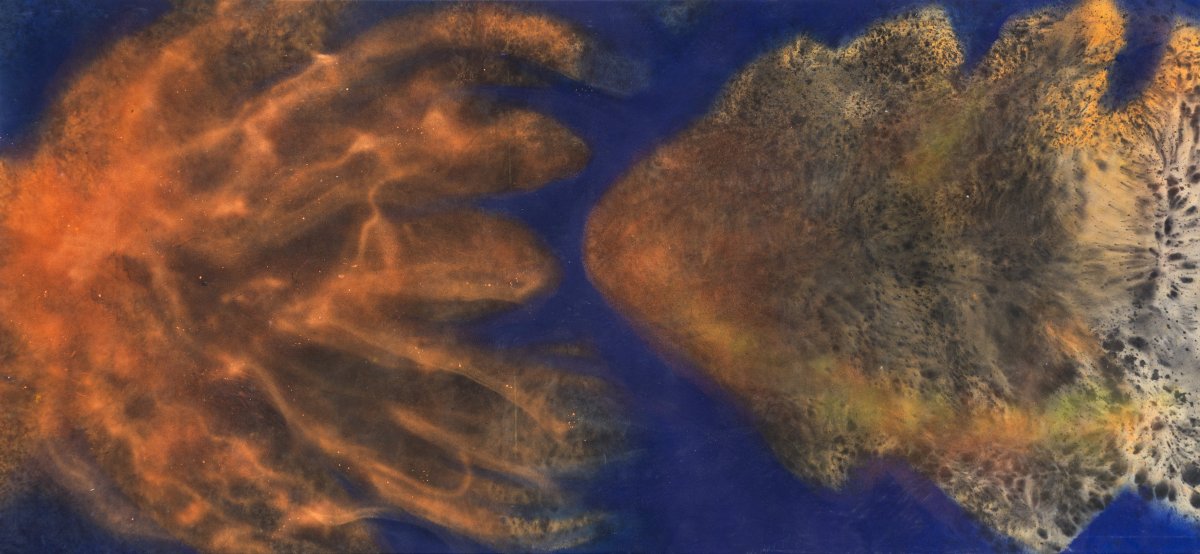
Kristína Nguyenová says that in her work she follows a path to the essence of things through their transformations. Her two paintings show at once the monstrous scale and the fragility of these transformations. Fields of colour pulse dynamically and in Rašení (Budding) they are shot through with lively brushstrokes. Yet the movement of this burgeoning growth is held back and fixed by static boundaries that determine its finitude. Her Touha (Desire) also creates a tension between movement and persistence. Two abstract, flickering objects drift on a deep blue ground. Unlike in Rašení, the tension here comes less from the contrast between movement and its limit than from the pull between that pair of luminous objects. One stretches out, unravelling its contours, perhaps to catch up with the form ahead of it and flow into it. The other, however, seems to remain closed to it, and the gulf between them stays unbridged. For good, or only for now. It may be a longing for union, and with it a longing to extend oneself in the stream of time. A newly acquired time, in which looking back is punished by petrification – in the light of the Old Testament story already invoked above, Turner’s Dřevo svázané plastovými řemínky (Wood Bound with Plastic Straps) may in this concept symbolize the human failure to accept time in its linearity and inexorability. But perhaps even such a transformation through failure is not final, and in time life will burst forth again from what has petrified – just as the wood of a post, cinched again and again by straps, keeps rippling and growing.


The concept presented here seeks to depict symbolically the transformation of the mythical human being into a critically thinking individual who is responsible for their choices and constantly comes to terms with their own limits in a new dimension of time. Among the distinctive poetics of the six artists, however, it also finds common ground precisely in what they leave unsaid: in the fact that they point to something that slips away and eludes us, something reason cannot fully see into. And perhaps a reversal takes place here as well. The question arises whether the path this suggests partly undoes itself, and whether, and to what extent, the space of the artwork might be the very place where the still-vanishing myth shines through. A space where, at least for a moment, the individual intention and deliberation of modern humans meet the experience of what transcends them.