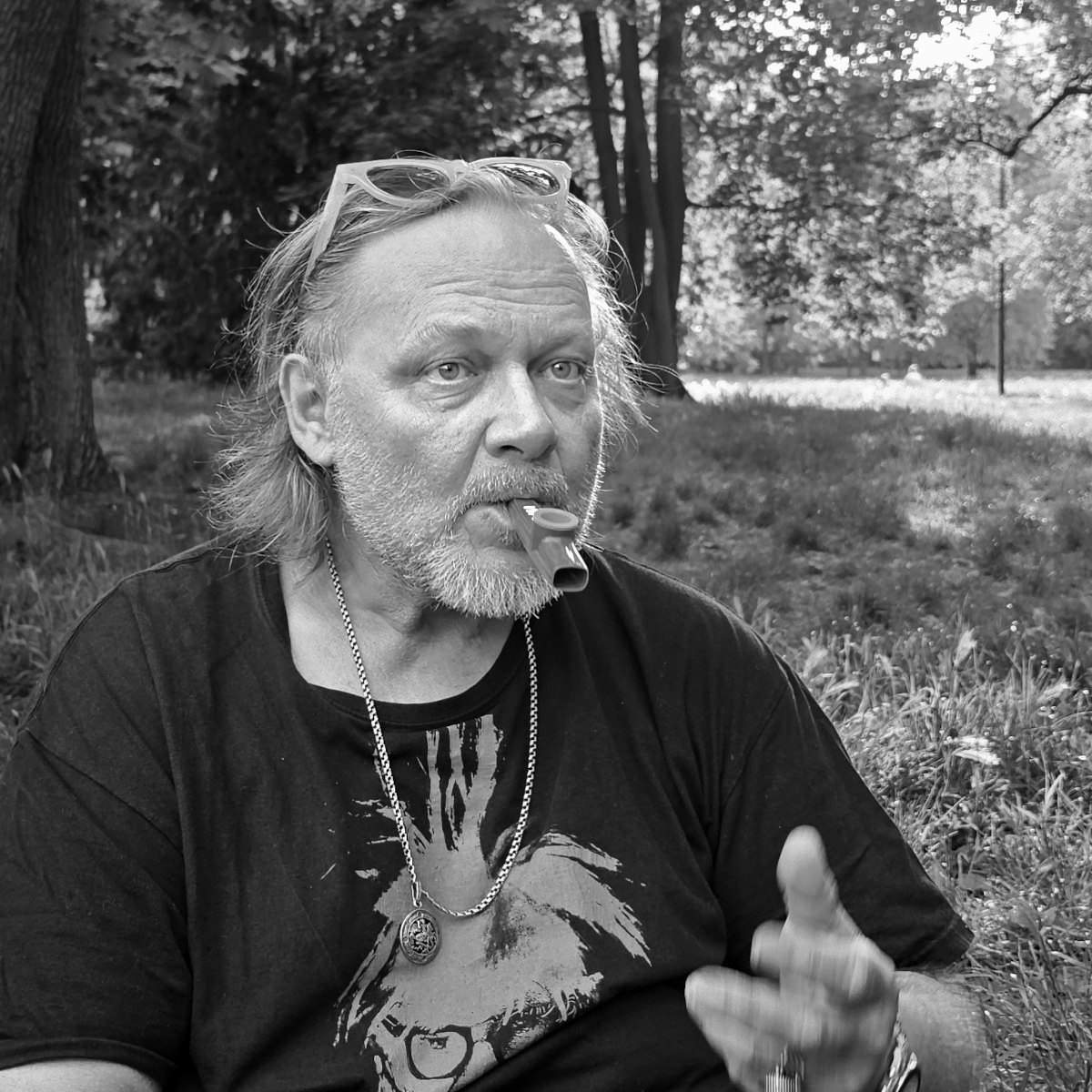
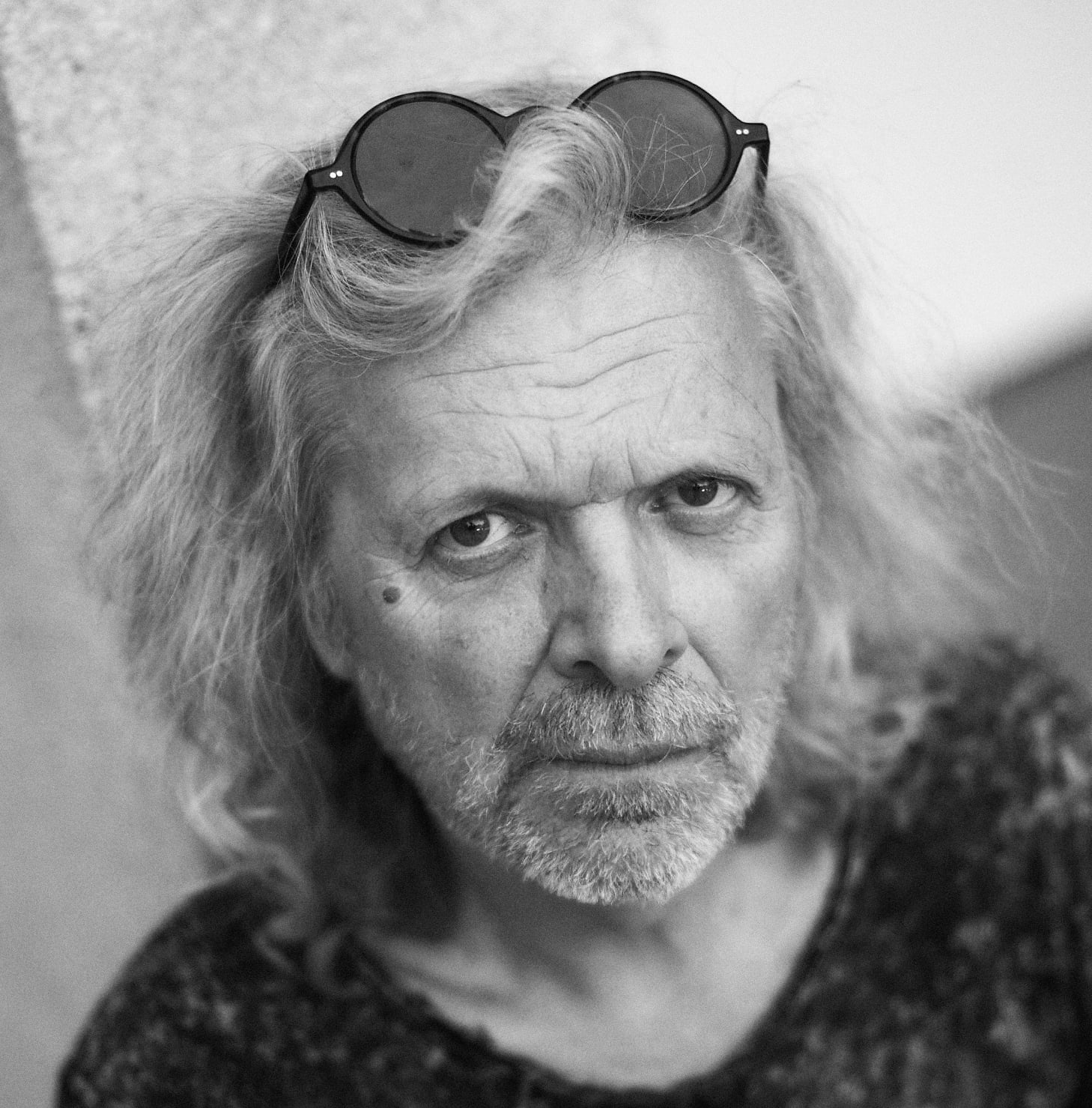
Jiří David is one of the most significant figures on the Czech visual art scene. Co-founder of the legendary Tvrdohlaví group, creator of the neon heart above Prague Castle, and an educator who shaped generations of Czech artists. This year he turns seventy.
How are you these days? What are you currently working on?
Thank you for asking. I'm doing about as well as my age allows – which is to say, not bad. Still ticking. I'm just finishing my latest larger series of oil paintings, a quarter of which will be exhibited in May at the Špála Gallery. I'm also preparing an exhibition for early July at a gallery in Karlovy Vary.
What will these new paintings be about?
It will be a series of oil on canvas paintings, completely different from my Faces exhibition at Hluboká. Very intense colors, sensuality, and completely simple motifs that gradually emerged during the artistic process. I didn't sketch or prepare anything in advance.
In our 2003 interview, we discussed motivation for creating. You said: "First, I enjoy it. And second, I feel that with visual art I can communicate something that I can't express any other way." Has your view changed on why today's young people want to create art? And do you still enjoy and get excited about it?
Yes, these are still some of the essential motives for my work in the studio, or even outside it. It's still a great adventure – the searching, the refusal to repeat oneself. That's why it's often a great struggle, sometimes despair and anger, then joy and excitement.
In 2003, you had just started at VŠUP (then the name for what is now UMPRUM) and said you were just "getting to know" the students and looking for a platform where you'd meet. In the end, you taught at UMPRUM for over 15 years before leaving in 2020. How do you view that pedagogical chapter in retrospect? And do you miss teaching?
Well, to be honest, I didn't exactly leave UMPRUM voluntarily, but that would take too long to explain. At first I certainly missed it, but not anymore. It's hard to evaluate myself even in hindsight. But perhaps it speaks for itself that many of my (our, because my colleague and assistant Milan Salák played an essential role) students have not disappeared from the Czech visual scene and many are now themselves educators at art universities across the country.
Back then, you criticized that Czech art closes in on itself, ghettos form, and society perceives artists as elitists. Has that changed?
Not much has changed in this regard either, it has slightly different contours, but essentially it's the same. Maybe it should be this way, I don't know.
You said you anxiously cancelled projects when you discovered something similar already existed. In the era of AI and endless visual smog – is it even possible to be original anymore? What is your relationship with AI?
I still perceive originality as unique fingerprints. Something very personal, even with flaws. AI doesn't quite manage that yet in the field of living art, and it's still noticeable. In the field of hand painting, it will really stay this way for a while. Undoubtedly in design, commercial and applied graphics, but also architecture, photography, and video, things will move much faster through AI and these areas will be displaced by AI, or rather people will be displaced from them. Personally, I currently use AI text modules for finding grammatical or stylistic corrections and for small quick translations, or some expert questions.
You're known for refusing to publish your paintings online – the screen, in your view, flattens the visual experience. Yet as an artist you're very active on Facebook, you write for Lidové noviny, Aktuálně and other media. You have an Instagram account, but since August 2024 you've been following only 180 people. What is your actual relationship with the online world?
Yes, that continues, for exactly those reasons. Of course you can't avoid situations where photos of exhibition installations appear on social media. From the studio, I basically never post my painted works. But I don't write for any media, only on Aktuálně.cz where I have my blog – though even that has become subject to advance monitoring, so despite being mine, it's subject to their editorial corrections and approval. So my texts no longer appear there very freely. I use Facebook regularly for communication, since my texts can't really go anywhere else. I use Instagram very sporadically – it basically doesn't interest me, I don't look at it, I just post something randomly about once a month. That's my online world, and according to my wife even that's too much.
Online consumes our time and attention at an unprecedented rate. But you established yourself before the mass spread of the internet. What were the most effective elements in your career back then? Personal meetings with a good gallerist? Or can you recall a moment when the internet helped your career? Today the situation is different and artists and their works can be discovered and shine even from geographical peripheries correctly connected to online attention.
I don't know how to respond aptly. It's always just a coincidence, but related to the intensity and belief in one's work. We were there at the birth of the first private galleries after 1989, so we were simply their family, we met at regular gatherings, discussed, kept an eye on each other and tried to show the other what we were good at or different. That's how individual exhibitions were born, and sometimes collector interest too (later). After all, we never did it primarily for any collections. Maybe social networks replace that today(?!), but for me they're too impersonal, cold, emotionless, universal. Certainly some type of medium handles and presents it better, but that passes me by. Not that I don't perceive it, but it actually bores me. There are probably "hunters" in these networks who are hunting in different territories and enjoy it. I don't know. (...) Anyone who truly collects art with heartfelt interest, and money, doesn't care about likes at all.
In 2003, our article referenced your then-domain jiri-david.cz. It's now unavailable and appears to be for sale. What happened – did you let go of the domain with your name?
I cancelled the website long ago (I described the reasons above), including the domain, and I foolishly thought, as I now see, that it would automatically disappear. So a domain can't be destroyed?
A domain doesn't disappear on its own. Contemporary art collections and investment funds have their expert advisors. Have you ever advised any of them on who to invest in? How does this work in Czech practice today? And what about foreign collectors – are they interested in the Czech scene or just in the gems that galleries bring to major fairs?
No, never, I've never advised anyone like that, nor come into contact with them. Perhaps some private collector may have occasionally asked me what I think about this or that person, and I probably gave them a non-binding personal answer. So I don't know how it works in practice, I can only speculate. Foreign collectors are basically still not interested in the Czech contemporary visual scene. And if so, only sporadically in certain individuals that someone shows them, for example at some art fair, and so on.
There are active artists who also advise large private collections and funds. In their role as filters or selectors of authors and works to be purchased, several possible types of conflicts of interest arise (they can harm competition for themselves or their "horses," gain power that can potentially be further abused, etc.). What's your view on this?
I don't think it's particularly harmful, because the local art market is so insular that this can't really do it any serious harm. However, it's somewhat obvious that if someone among active artists does this for payment – and I honestly don't know anyone like that, but they probably exist(?) – then they might influence something small somewhere. But no real power comes from it, and if any, only the local marginal kind.
This year you turn seventy. What message would you give to young artists on their path to happiness?
A smile, nothing surprising – simply believe in what you do, don't try to be "in" at any cost, but at the same time know what's happening in the world and especially know what the memory of art itself contains. Then it's just lifelong continuous work – and nobody is going to do it for you.
Thank you for the interview. (Below you will find a review of the new film Is It Worth It?, in which Jiří David is one of the protagonists and whose theme is related to our interview.)
Jiří David: Review of the film Is It Worth It?
The film Is It Worth It? undoubtedly deserves critical evaluation – though not in the form currently presented by those who either lack deeper understanding of the mechanisms and economics of the art world and merely adopt fashionable ideological shortcuts, or who know enough but deliberately reinforce current trend stereotypes. Available information indicates the film was in production for almost seven years. Over such a long and unanchored development horizon, it is extraordinarily difficult to maintain dramaturgical unity, consistency of interpretive framework, and contextual stability – a long-known problem in documentary production, especially for films tracking shifting social environments. Director Jan Strejcovský undoubtedly tried to bring it together, but the material inherently tended toward fragmentation.
I consider the inclusion of a young emerging artist performing under the pseudonym "Dante" a fundamental dramaturgical error. His presence adds nothing new, unexpected, or aesthetically or interpretively relevant to the film's overall statement. From the perspective of film dramaturgy, which should (especially in documentaries about professional environments) stand on representative yet differentiated selection, this is a problematic choice. In the context of contemporary art practice, his participation acts as a disruptive element that deforms the film's implicit value map.
Regarding the documentary format itself, it must be re-emphasized what documentary film theory confirms today (from Bill Nichols to Stella Bruzzi): there is no such thing as a "pure" or "neutral" document. Every documentary is a form of construction, montage, and interpretation of reality. Manipulation is not a defect but an immanent feature of the medium. What matters is the degree of reflexivity and transparency of this manipulation. However, Is It Worth It? reflects its construction only minimally and rather gives the impression of an objective view. In reality, it is an authorial narrative – an artistic object presented as documentary testimony.
The film's editing structure, based on significant temporal layering, occasionally shifts or changes the meanings of individual statements. For viewers unfamiliar with the sociology of art practice (Howard Becker's "art worlds" concept or local specifics of grant, gallery, and collector structures), the film becomes difficult to read, almost impenetrable. This groundlessness leads lay viewers toward stereotyping, while insiders necessarily lack expert correctives – contextual frameworks that would give statements clear professional and value dimensions.
The dominant position in the film is occupied by activist artist Epos 257, who is presented – not only through directorial perspective but primarily through his own performative behavior – as a moral arbiter. His figure is assigned the role of an "ethically unquestionable" subject, which fundamentally affects the proportions of the entire story. In his light, collector R. Runták is presented one-sidedly, as an almost demonized "executor-devil" figure whose economic past allegedly directly legitimizes interpreting the art world through the lens of artwashing.
This reduction is problematic from several perspectives:
- It obscures the plurality of motivations and structures in the collector environment, which is actually heterogeneous and requires complex analysis.
- It creates a moralistic binary ("pure activist" vs. "corrupt collector") that does not correspond to the real mechanisms of cultural economy functioning.
- It ignores the broader discussion of ethics in art, which cannot be equated with one activist position, however loud.
Also problematic is that during filming, it was not known – neither to me nor, it seems, to the film crew – that Epos himself operates in the real estate sector, rents studios, and runs various workshops, placing him in a significantly stronger economic position than the film suggests. This itself is not a problem; what is problematic is the unrealistic film construction that casts him as the only "pure," almost ascetic subject. From a professional standpoint, such selectivity can be termed narrative asymmetry, which weakens the film's credibility.
I also find the use of staged, stylized études particularly unfortunate. These definitively remove the film from the documentary genre and shift it into hybrid "docu-fiction" territory. Hybridity itself is not a problem (it is today a completely legitimate artistic approach), but here it is deployed without sufficient thought and bears features of lyrical melodrama that disrupts the work's coherence and prevents clear reading.
The other subjects – Olga Trčková, Zdeněk Sklenář, and René Rohan – each open up independent topics that would require more detailed analysis of gallery sector representation, institutional power, and cultural policies, which the film hints at but does not articulate.
In conclusion, the film could have been significantly stronger in the context of local art practice had it shown more respect for its internal logic, hierarchies, professional ethics, and social stratification. Nevertheless, it may represent a certain insight into the contemporary art segment for a broader audience, albeit heavily burdened by the director's interpretive framework. If more feature-length films about art were made here – with different perspectives, methods, and ambitions – their perspectives could complement each other and enable truly pluralistic, professionally grounded discussion.