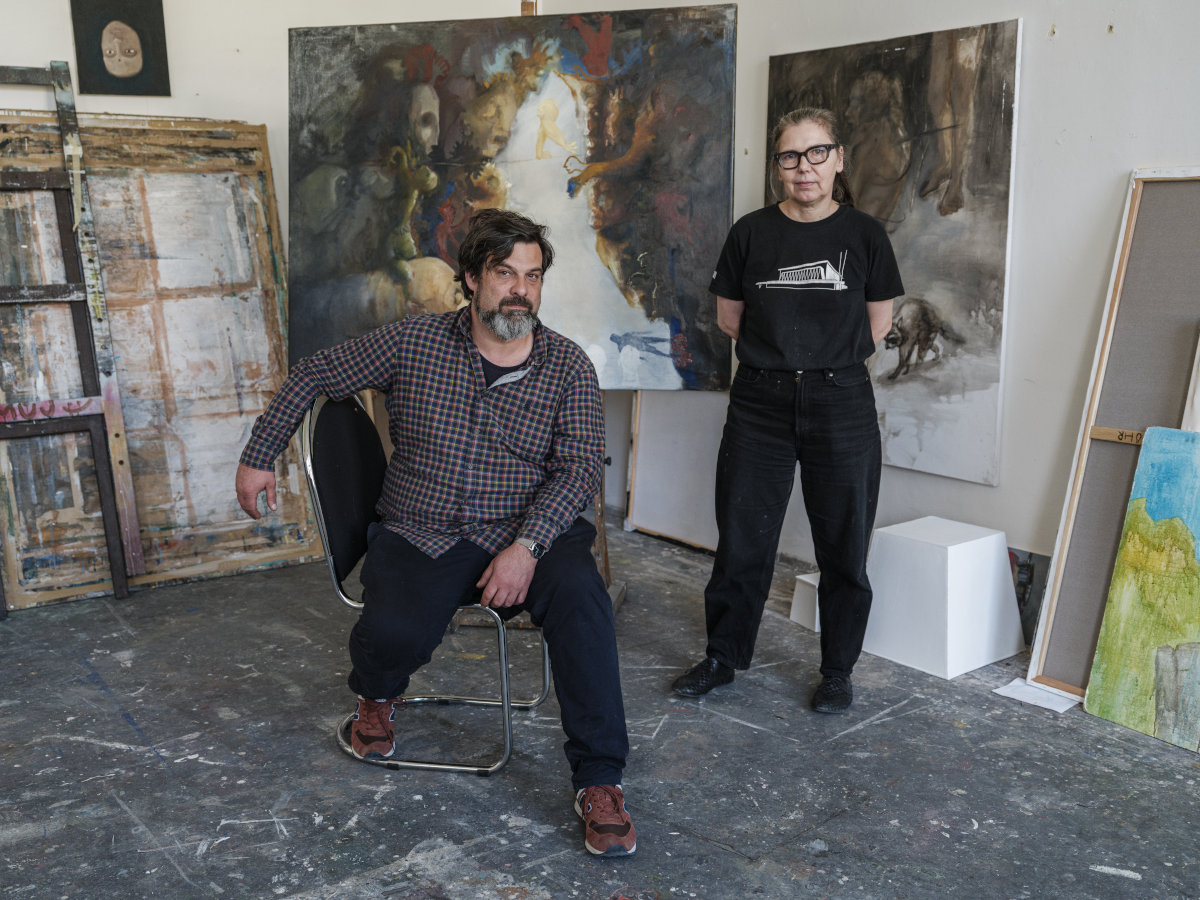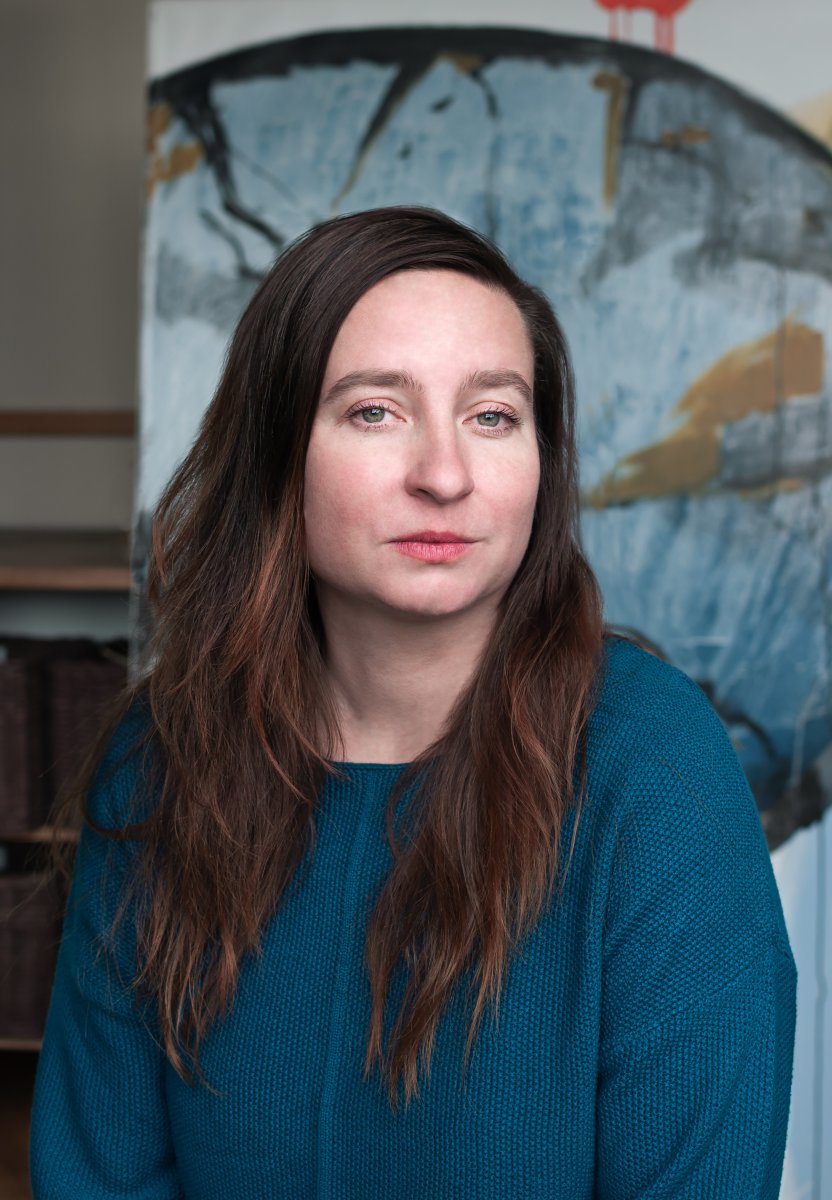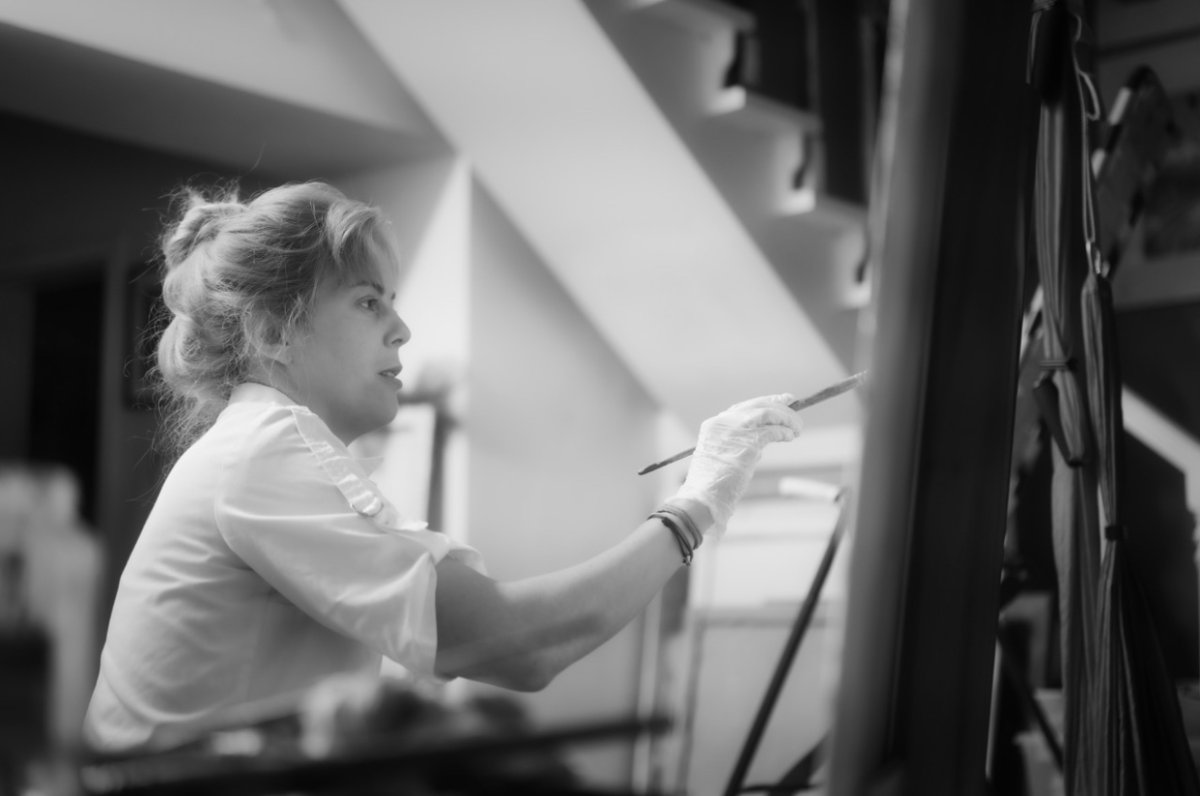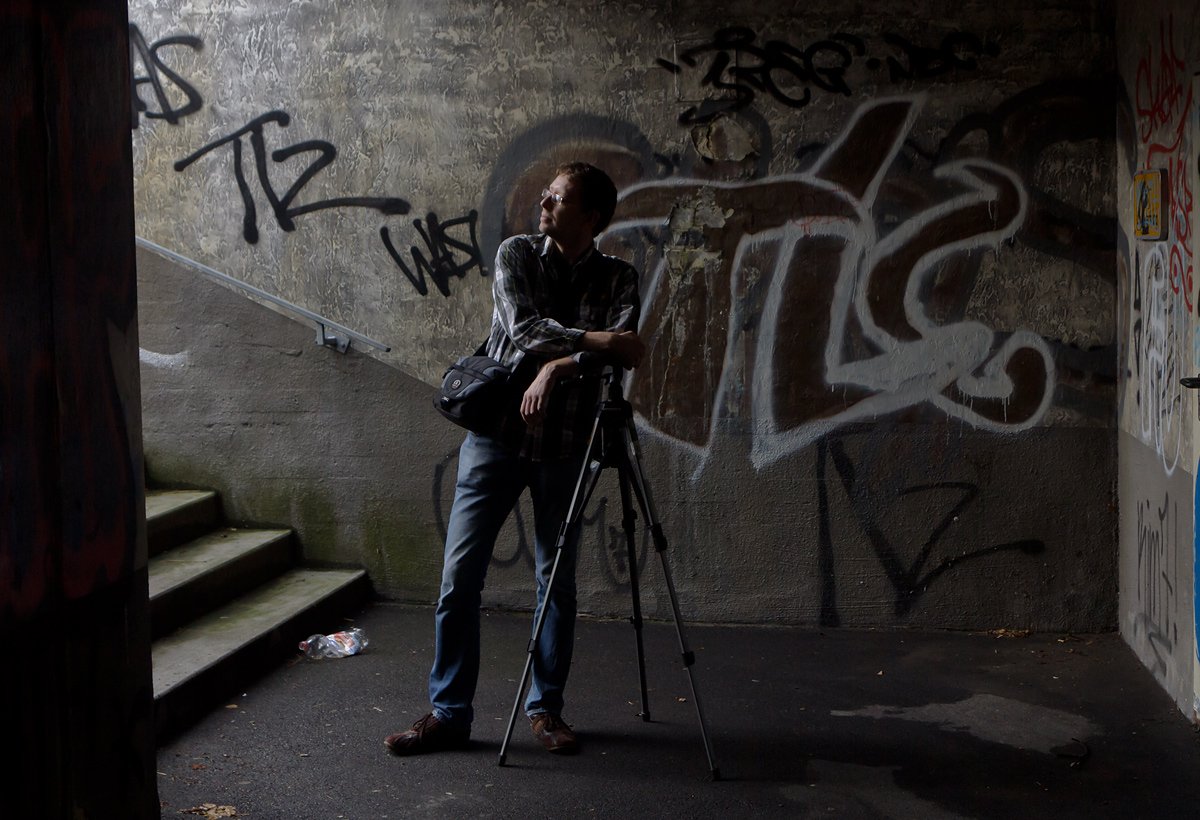
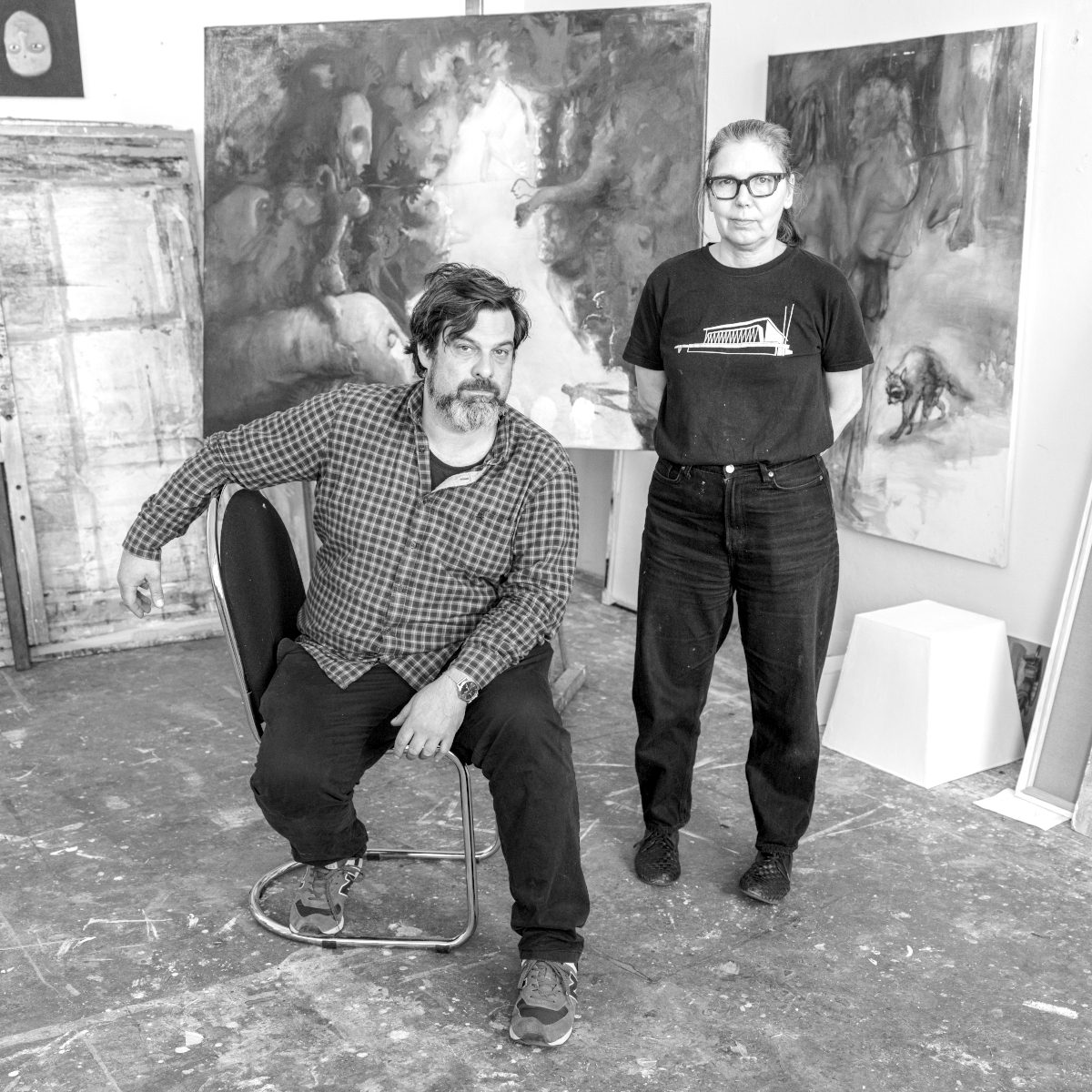
Hana Puchová and Jiří Ptáček only recently took over the painting studio at the Faculty of Arts, University of Ostrava, succeeding Daniel Balabán and Václav Rodek. They have no graduates yet and have just been through their first admissions round. Our conversation with them therefore deliberately captures not a retrospective, but a beginning – with everything that comes with it: enthusiasm, uncertainty, and early clashes with institutional reality. That is precisely why we wanted to talk to them now, rather than in two years when everything will be running smoothly and the answers polished. Although we are on informal terms with both in everyday life, for the purposes of this interview we reverted to the formal mode of address.
How many students were already in the studio when you arrived? And how many are applying for the admissions coming up in two weeks? How many do you plan to accept into the first year?
Hana: There are more than forty students in the studio, and we will probably accept six or seven.
Jiří: Working with that many students is extremely complicated. At our very first meeting, one student told us frankly that he simply could not imagine a group consultation for the entire studio. He was right – we had to take a different approach and combine various types of consultations on multiple levels. The building itself does not offer enough space for everyone to work on site either. We are actually lucky that some students prefer working in their own studios. We either visit them there or they have to bring their work in when their workspace is outside Ostrava. In any case, with this many students, individual consultations depend heavily on the students’ own initiative. That has its advantages – the consultations are driven by their needs – but also downsides, since it can happen (and it did) that we barely saw a few individuals over the course of the first semester. I see this as a problem we need to address actively, one we inherited from the studio’s past.
How did you come to teaching? Was it a deliberate decision, or did it happen gradually?
Hana: I was drawn in by a project led by Helena Balabánová, who set up a school to educate Romani children. That was in 1996, when I was still a student at UMPRUM (Academy of Arts, Architecture and Design in Prague). At the time, it was still quite common for Romani children to be automatically placed in special-needs schools without any proper assessment. Helena wanted to create a school with a kinder approach. It was also the first school to establish positions for Romani teaching assistants – and possibly for teaching assistants in general. Before that, I had never thought of myself as a teacher, but the project attracted me. I started there in 1997 and it completely drew me in – all those children and their stories – and in the end I worked there until the end of last year, nearly thirty years. I was happy there, but at the same time it was very draining. For the last few years I had a reduced workload, but even so I had been feeling for a while that I needed a change of environment.
Jiří: You may recall when I started visiting FaVU (Faculty of Fine Arts, Brno University of Technology). First as a friend of Daniel Vlček and a green art history student who was soon invited to sit on semester review and thesis defence committees. The Brno school grew close to my heart, so when Dean Michal Gabriel invited me in 2009 to take over teaching in the Video Studio after Peter Rónai, I happily accepted. My partner there was Jesper Alvaer, followed by the new – this time competitively selected – head, Martin Zet. Later I lectured at Prague College, and to this day I teach one course at UMPRUM in Prague. Over the past twenty years, though, I have had occasion to visit most Czech fine art universities. In 2017, Michal Kalhous, Dean of the Faculty of Arts in Ostrava, asked whether I could fill in for one semester in Petr Lysáček’s studio while he was heading to China. It was a challenge for me, because I always prefer direct interactions with young artists over lecturing on art history and theory – moving from their primary interest, their own art, toward theoretical frameworks and broader contexts. The students gave me good feedback at the time, and I promised them that if Petr ever left, I would apply for his position. Which I did. I did not get it, but I was fine with that. The winning duo of Pavlína Fichta Čierna and Tereza Velíková fulfilled a different idea of mine – that the faculty’s teaching staff needed more women. And that is something I simply cannot provide, no matter how hard I try. Besides, had it not been Hana who invited me to Ostrava but, say, Karel or Standa, I would have said no. Our studio is predominantly female, and I have the impression that the students communicate differently with a woman teacher than with me – out of a kind of instinctive trust that some of their life experiences are closer to hers than to those of Ptáček the teacher. And I like that.
You have been running the studio for a semester and change. Everything is happening for the first time – the relationship with the institution, with students, and between the two of you. What surprised you the most? And what did you imagine differently from how it actually turned out?
Hana: I am surprised practically every day, still adjusting and figuring things out. I was surprised to learn that, for now, I cannot supervise students during their master’s thesis – apparently that is standard, I just did not know it. The structure of teaching also turned out to be somewhat different from what I remembered from UMPRUM. Another surprise was the striking predominance of women among the students. And of course there is a huge difference between the pupils I taught before and university students, though I would say they share a certain fragility. I invited Jiří to join me and I am very glad he accepted. Not only because I feel out of my element in the university system and Jiří navigates it better, but above all because he offers the students his distinctive experience and breadth of vision. I am equally grateful for Radek Petříček, who brings yet another kind of sensitivity and expertise. We often see things from different perspectives, but I would say we listen to one another, and I believe the students benefit from it.
Jiří: A pleasant surprise was that the students accepted us – or at least did not let on that they didn’t. You know, Daniel Balabán is an excellent painter, and I always enjoyed listening to him talk about paintings whenever I was in Ostrava. I also hear from students that Václav Rodek was a good teacher with whom they had a strong relationship. The two of us are obviously different. We are both rather talkative. We like to laugh – for some people it might be hard to read us. Though perhaps I’m giving us too much credit and we are actually an open book to them. Another pleasant surprise is how much I appreciate Hana’s remarks on the students’ work. I would happily study under her. The less pleasant part is, of course, the university administration. I have more experience with it than Hana, yet even I have caught myself fuming over it – especially when I see that it is not designed with the students’ needs in mind. We are greatly helped by the patience and goodwill of our “mentors” from the second painting studio, František Kowolowski and Jiří Kuděla, and by the approachable manner of Dean Michal Kalhous. Anyone who has ever worked in an institution will confirm how crucial it is to have someone on the front desk who is willing to help newcomers with their problems. At the Faculty of Arts, that person is Hana Kuchtová – another being with inexplicable patience. We are learning as we go, constantly discovering new things, asking why nobody told us this or that, but we are gradually putting it together, and over the summer I am going to make time to present the Dean with a few suggestions for what I think could be improved.
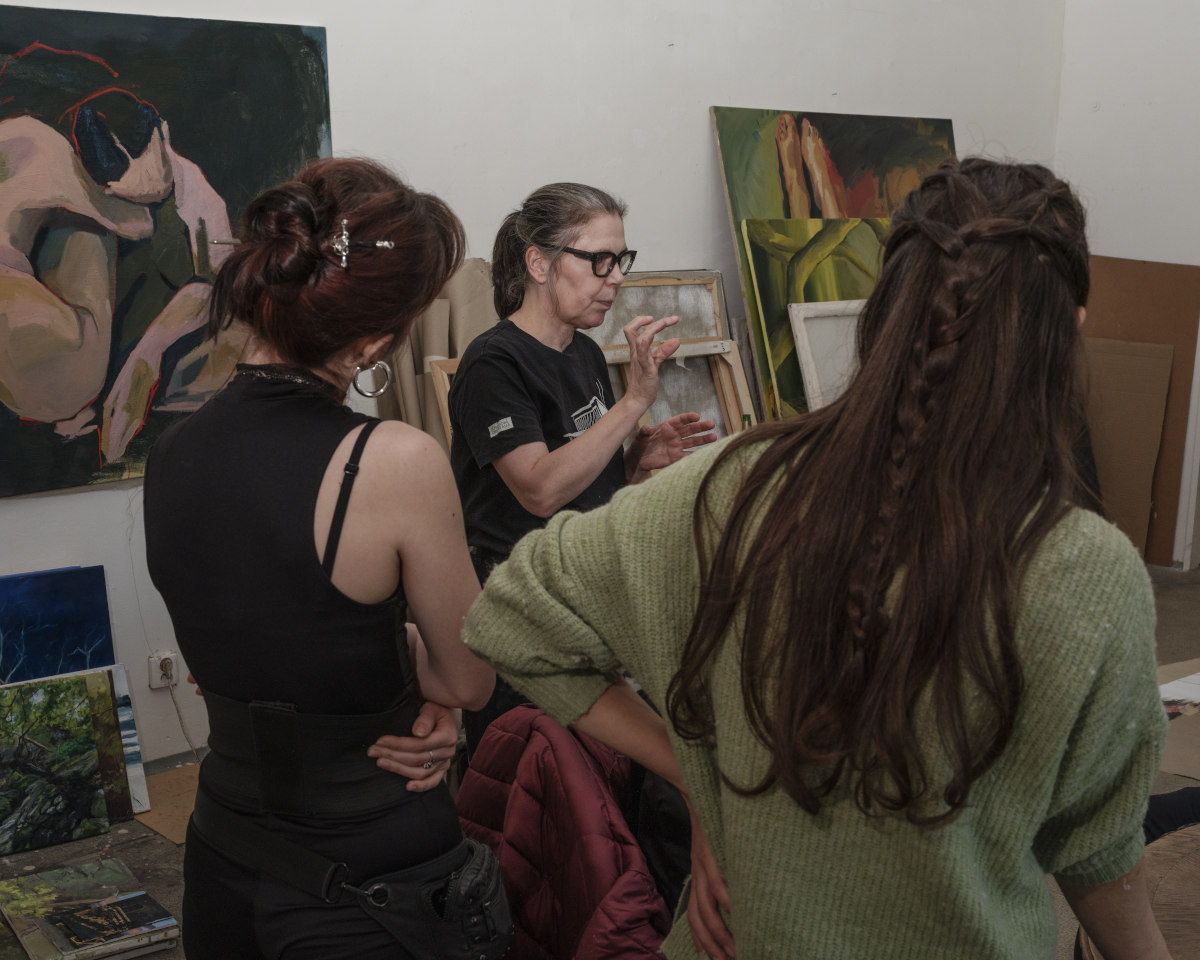
Jiří, you have written that it is sometimes a comedy, sometimes a drama – hopefully not a tragedy. Can you describe one specific moment from the first semester that captures this?
Jiří: We try to do our best. We try to be friendly, factual, correct; we use the formal mode of address. We try to give everyone our time. Maybe we really do talk too much, and when we descend on a consultation as a duo, I genuinely think there is a real risk that the students’ heads will explode. But to find out whether it is a tragedy, you will have to ask them.
Hana is a painter rooted in the Ostrava underground scene of the 1980s; Jiří is a curator and critic moving between Prague and České Budějovice. How did you actually meet, and how did you agree on running the studio together? Do you divide the work, or is it one organism?
Hana: So far, we mainly know each other’s bright sides – we are still getting used to each other (smiles). I really wanted to have someone in the studio who could give the students something I cannot. I mean a different kind of sensitivity and personal and professional experience. I knew Jiří’s work, and we got to know each other better during an interview for Art Antiques. I liked how and why he asked questions, and how he listened. Later I exhibited in České Budějovice and again I liked how everything was handled. I am very glad Jiří came on board; he notices things differently from me, and I appreciate that. Radek Petříček also teaches alongside us – he too is kind and understands painting technique better than I do, offering the students yet another perspective. We are available to them both together and individually. I am curious about their opinions, and it seems we are getting along well.
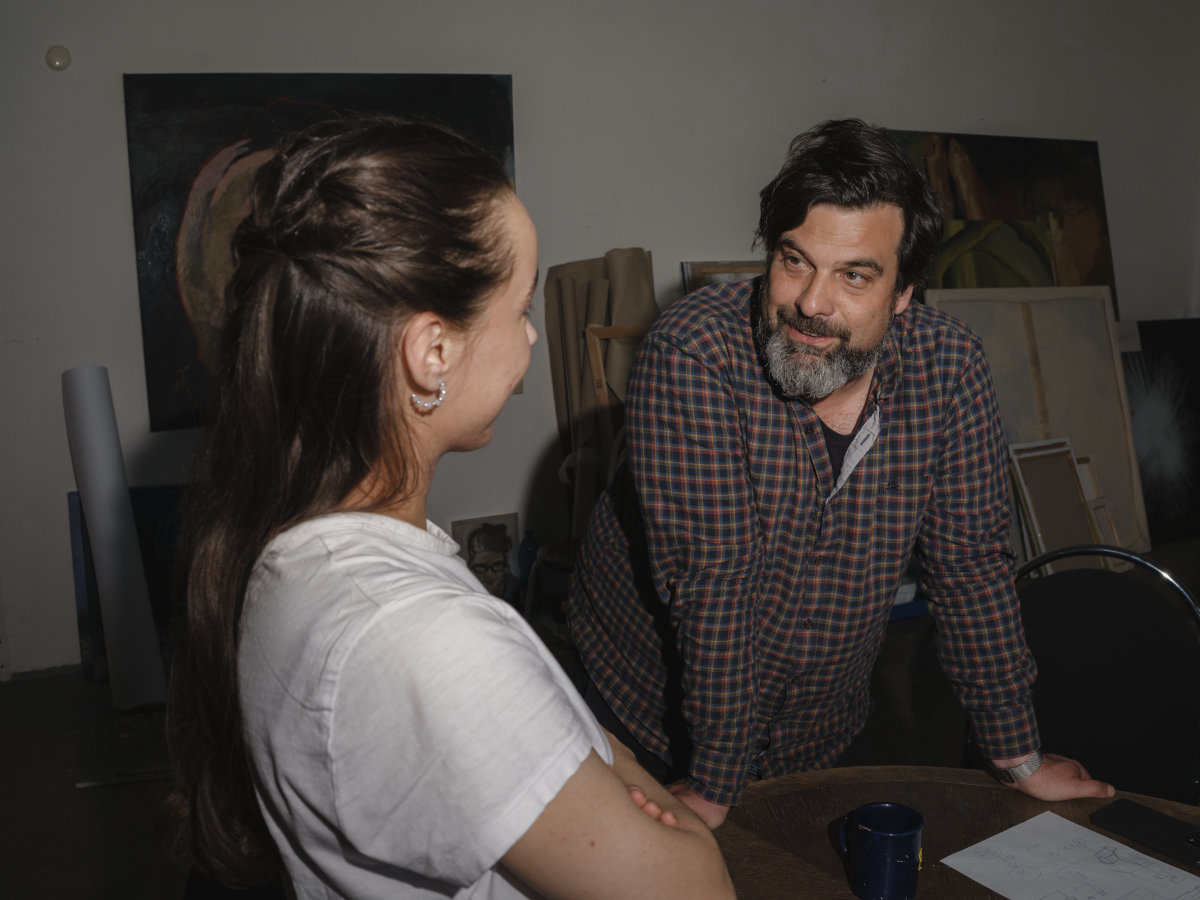
You have no graduates yet; the first admissions have just taken place. What do you want your students to take away from the studio? What is the single most important skill or attitude?
Hana: I feel great satisfaction when an artist knows what they are doing and why, when they know what they want to express and how. When they are not afraid. Or when they are afraid but try anyway. When they are free. When they are – and remain – curious.
Jiří: An art school produces graduates with master’s degrees in fine arts. Still, I believe an essential part of the “education” they gain should be a deeply internalised awareness and habit: that there is always somewhere further to go, something to explore and open up – in their art and in themselves. And equally, to maintain a sustained attention to the art that is being created and will continue to be created around us.
What do you look for in applicants? Is there anything that can convince you immediately – or, conversely, put you off?
Hana: Naturally, the quality of their artistic work plays a major role. And then – I may not be able to describe it precisely – some applicants capture your attention almost immediately, probably through their openness, authenticity, originality, curiosity, eagerness to work. How they respond to various prompts and how they communicate also matters.
Jiří: I was struck by the fact that within the overall admissions process, the home portfolio carries relatively little weight. Yet it is in the portfolio that you can clearly see who devotes time to art, who experiments and tries new things. During the admissions themselves, nerves can interfere, or the applicant may simply not connect with our particular assignment.
Does your programme include any instruction in digital literacy for artists – building an online portfolio, working with social media, self-presentation? Which online platforms do your students most commonly use to showcase their work?
Hana: Almost all students have Instagram, but to be honest, online presentation is not my priority at this point.
Jiří: Starting next academic year, I would like to bring my UMPRUM course to Ostrava. It includes a section on working with social media – not in enormous depth, but mainly as an introduction to a topic that, in my experience, not everyone views purely positively. I teach what Instagram is good for, why Facebook – the old-timer – still has its uses, and what a static personal website brings. I show examples of how other artists approach this. I do not, however, devise specific strategies for the students – dinosaurs should not be advising avatars. So far, I have only invited both painting studios to an evening lecture on how to put together a functional electronic portfolio. Nobody from the other painting studio showed up.
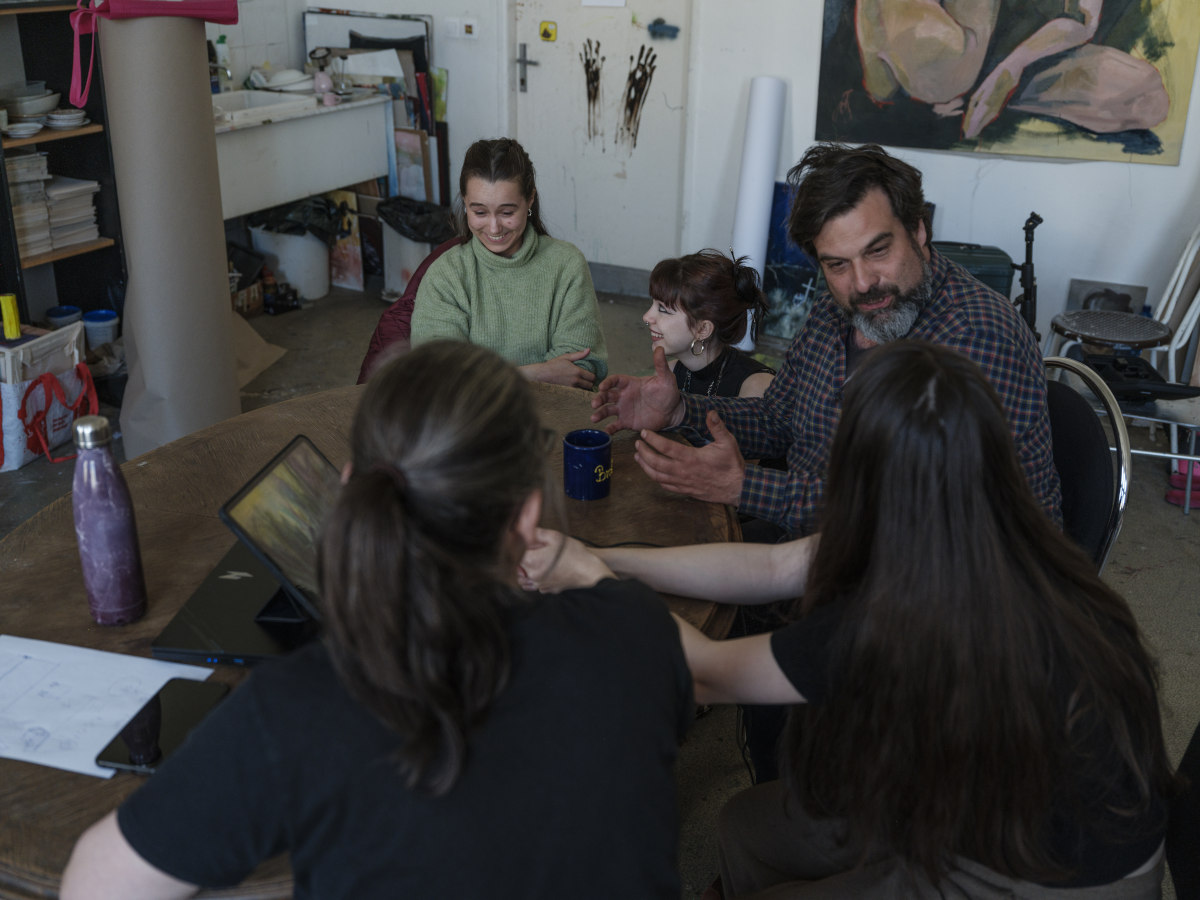
Do you plan to collaborate with galleries or institutions so that your students gain contact with the real art world while still studying? Jiří, as a curator you have an extensive network of contacts – do you draw on it?
Hana: The students want it; it matters to them, and I keep it in mind. We really miss PLATO Bauhaus. We have a few modest things lined up here in Ostrava – hopefully they will work out.
Jiří: For me, it is surprisingly harder. I do not want to exploit that network for exhibitions that are not thoughtfully conceived. I do not want a student show to stick out as looking like a student show. We do have something up our sleeve, but in the first year we needed to focus primarily inward, on the studio itself. Just last week, though, I helped our student Jana Krčmová select and hang an exhibition – only in the club space of the Petr Bezruč Theatre, but even there we were figuring out hands-on how to work with a space, what it can handle, and what simply cannot be done in it. It was enjoyable, because Jana is a talented painter with a strong drive to take her art out into the world. And it paid off for me, too – she brought me a sausage today as a thank-you. What I currently miss in Ostrava is a solidly run off-space where young artists could show their work. They have the Dukla, occasionally Galerie Dole, and a fairly decent school gallery in the new faculty building, which mainly houses the music department. Even so, I would welcome at least one more gallery specifically aimed at young artists.
Power dynamics between teachers and students are a topic of discussion in art education. What mechanisms exist at your institution to prevent the abuse of authority, and do you consider them adequate?
Hana: The faculty has an ombudsman and offers psychological support. I know they exist, but I do not yet have any practical experience with them. I try to make clear that we are here for those moments when things are not going well, for whatever reason. But I am still finding my bearings.
Jiří: That said, Hana and I do discuss power dynamics within the studio. We do not forget the power we hold. We do not want to make mistakes, not even by accident. And they do happen. I genuinely love inventive, extravagant clothing. I enjoy seeing how young people experiment with fashion, and I sometimes ask them where they got something. But the other day I ran into a student unexpectedly in the doorway and told her she looked good. I immediately realised I had overstepped and quickly added that I liked her outfit. Hana and I confirmed right afterwards that it had been a misstep. I honestly could have slapped myself, because I had commented on someone’s physical appearance. Hana had half-jokingly told me at the very beginning that she would keep an eye on me. And I take that seriously. The number of men who treated the school as a cabinet of free love was staggering. Our task is not merely to avoid falling into anything like that, but also to remind the students regularly that we will support them if they ever feel someone is treating them badly. I can also be quite critical, and it takes diplomacy and an ongoing dialogue to make sure a student understands that a critical remark changes nothing about the fundamental fact that I find them and their work worthy of attention and care. That also takes time and mutual understanding of roles. Last but not least, it is our job to recognise when an issue is beyond what we should be handling ourselves and when to seek help through the mechanisms you mentioned. We are not therapists, but we can offer help from a qualified person – right, Hana? That necessity has already arisen. At the same time, it will probably take a while before the students get used to the idea that they can come to us when something is troubling them. And when they do, the challenge is not to betray that trust by carelessly letting something slip.
Ostrava positions itself as an alternative arts hub – PLATO, Colours of Ostrava, a lively independent scene. How does the Ostrava environment differ from Prague or Brno from a teacher’s perspective? And is it an advantage or a handicap for your students?
Hana: I do not see Colours or PLATO as the alternative scene. And forgive me, but I have only been at the faculty for a few months and I don’t feel equipped to answer that from a teacher’s perspective. From an artist’s point of view, I notice that the distance from Prague to Ostrava is still greater than the other way round.
Jiří: The years of study are, among other things, a period of forming important professional connections. The Ostrava scene is vibrant but not large, so it is natural that these connections develop within it. I consider it one of my tasks, however, to help open up the channels between Ostrava and “the rest of the world.” The distance from Prague to Ostrava may always be greater than the reverse, but what matters to me is that from Ostrava, it should feel close to anywhere.
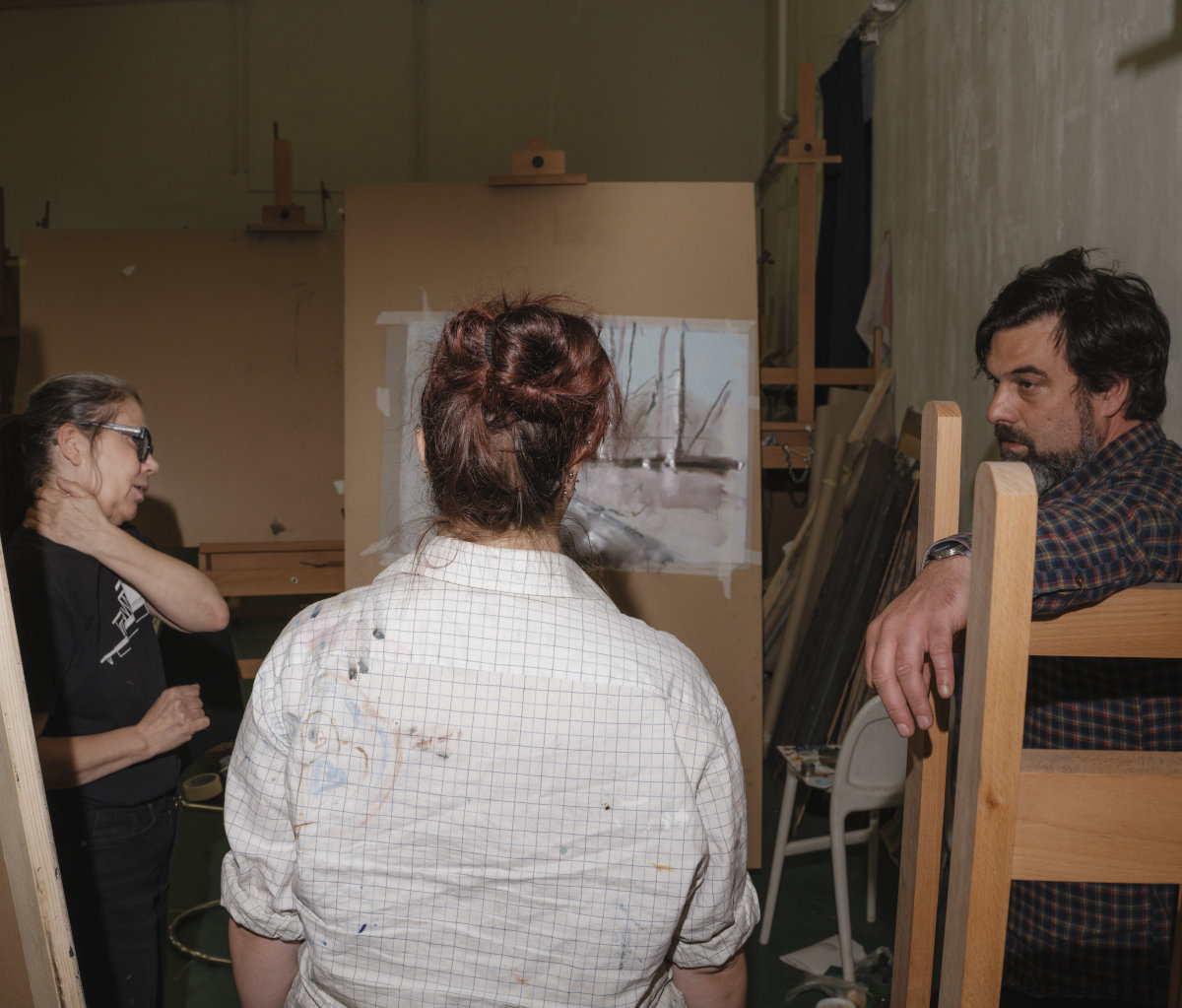
You are involved in the case of Bedřiška, a former mining colony in Ostrava that has transformed from a socially excluded locality into a functioning community of Roma and non-Roma residents, which the local district nevertheless wants to demolish. How can an artist stand up for their immediate surroundings? Do you consider civic and social engagement part of what an art school should teach, or is it a personal matter for each individual?
Hana: As for Bedřiška, I am not particularly active – I am more of a supporter from the sidelines. I would say that an artist can and should get involved just like anyone else, perhaps just in a different form. I do not avoid these topics at school. It is important to me to be able to express a civic stance, show solidarity, and have social sensitivity – but I would still leave the degree and manner of personal involvement up to each individual.
Jiří, you have been similarly engaged in the cultural politics of your home city of České Budějovice – you co-founded Spolek Skutek (an artists’ advocacy association), ran the Galerie Měsíc ve dne, and you are vocal about the city’s cultural policy. How can a visual artist or curator genuinely influence what happens in their city? And do you manage to bring what you learn in that practice into your teaching?
Jiří: I got involved in Spolek Skutek because I felt a lack of collective voice among those working in the visual arts. Although the reluctance toward associations has deep historical roots and is also linked to the individual nature of artistic work, they are necessary so that we can address shared or at least overlapping concerns. České Budějovice is a different story. I started there as a curator and art critic and wanted to keep in touch with the city even though I lived in Prague. My friends there felt a certain kind of visual culture was missing, so at one of their apartments we would clear out the place several times a year and turn it into Zutý Mánes, an apartment gallery. Occasionally I curated an exhibition for Michal Škoda at the Dům umění (House of Art). After returning to the city twelve years ago, however, I began paying attention to local culture on a broader scale. That, in principle, might not have led to any kind of activism. I was pushed toward it by the attitude of local politicians toward cultural spaces like the Dům umění or toward art in public spaces. I never actually sought to be an activist. Over the past three years, my work on the city’s cultural committee has helped me better understand the whole of the city’s cultural landscape, and I may have even managed to improve a few things. But the city’s leadership probably sees me mainly as a perpetual critic who only complicates matters – and so the best strategy is to ignore him. It is a great shame that politicians automatically read critical feedback as political point-scoring. And let me be clear: I am talking about critical positions where I always try to propose a viable solution. In Ostrava, I would not dare do anything like that. I am a “visitor” and I have no wish to lecture people who know their city and its culture infinitely better than I do. When they ask for my opinion, I will gladly offer it. I try to bring these experiences into my teaching gently, as something that is a little painful but may surface in some form in a young artist’s future life.
To close – what advice would you give to young artists at the start of their journey? What does it take to persevere and build a sustainable career in contemporary art?
Hana: Honestly, all that comes to mind are things that sound obvious: hard work and perseverance. And the drive to bear witness and the need to share. Accepting help when you need it, building and strengthening friendships. And holding on to that curiosity I mentioned earlier. That has helped me a lot.
Jiří: Just a note on perseverance. It is not easy to persevere in an era when the insane faces of civilisation are leaping at us from every corner: climate catastrophe, brutal armed conflicts, the erosion of humanistic values, and the threats posed by the breakneck and, for a layperson, barely predictable development of technology. It is not easy to live in this era, let alone come of age in it. Perseverance in our world depends on the careful yet difficult task of holding on to hope – including in relation to art, which ought to contain that hope even when it seeks to express feelings of profound despair. Hope rooted in the trust of sharing the burden.
Thank you for the interview!