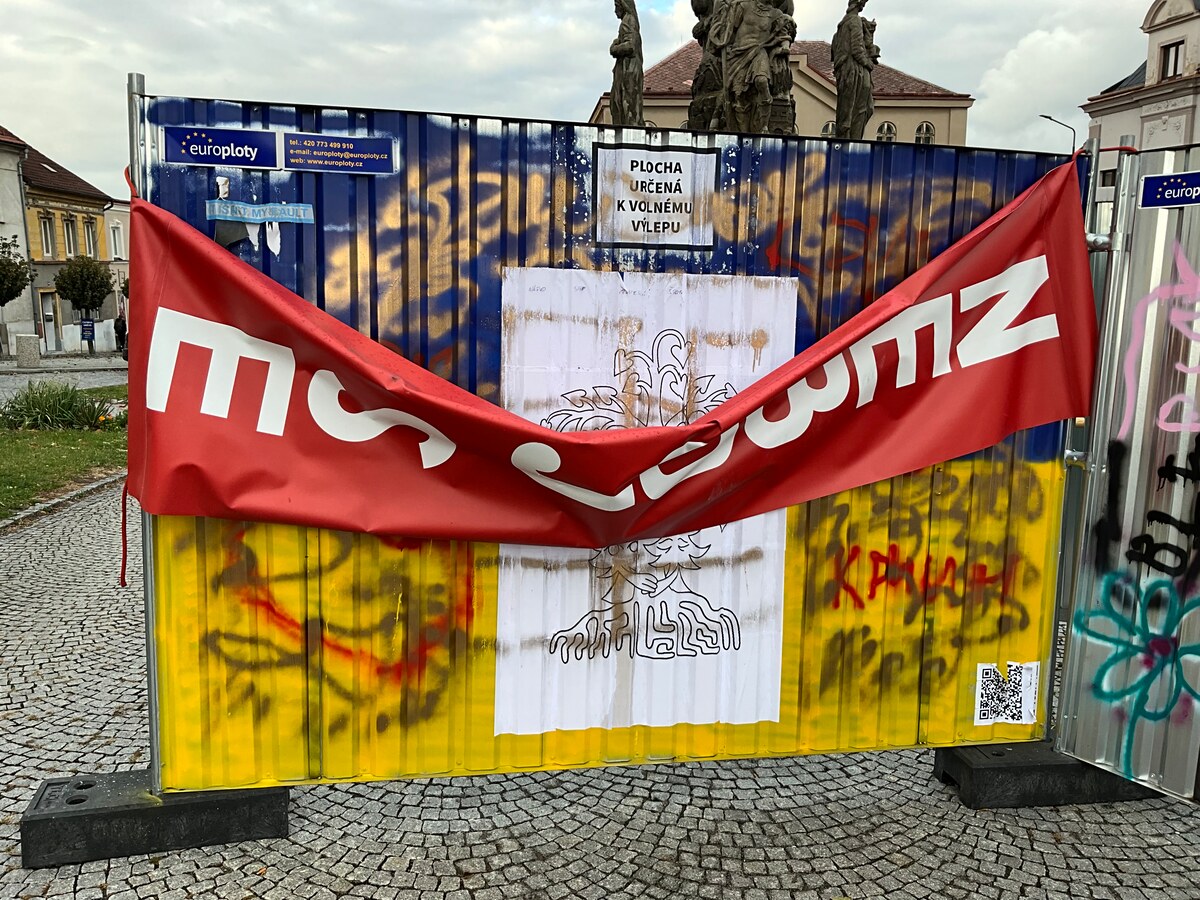
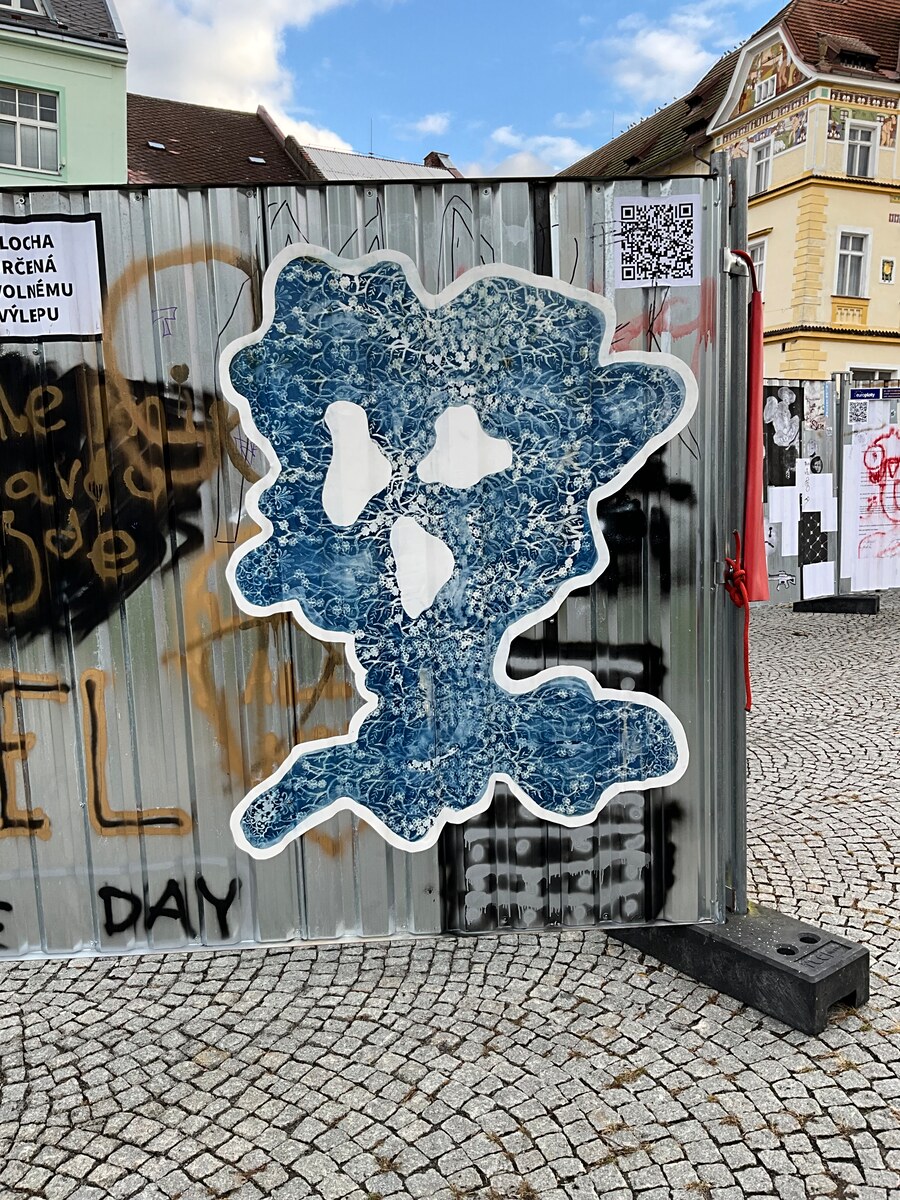
Johana Merta has had her profile on ArtGraduates since January 2026. This autumn people began talking about her far beyond Skuteč. Her processual expanded sculpture Ó Europe, I cry for You, made of construction fences below the Marian column on Palackého náměstí, stirred up the calm waters of a town of five thousand and reached the national media (the sharp rise in searches for her name did not escape us either). In the end it was removed by agreement with the artist. Stanislav Biler’s report in Deník Alarm approached the whole event sociologically and with irony towards the locals.
We wanted to know how the artist herself sees the whole affair, and what life is like for an artist who makes mostly conceptual works that usually cannot be sold and that often even her fellow townspeople do not understand. We also asked her why she and her family moved from Brno to Skuteč, and why she actually needs to create.
Johana, you and your family moved to Skuteč in the summer of 2020, in the middle of the covid pandemic. What brought you here of all places, and what is life here like for you after all these years?
We’re originally from Brno. And when we started planning a family in 2012, you could start to feel the housing crisis strongly in the air. Over time our children were born one after another, so we searched for something “of our own”. After seven years of intensively driving around to see properties, we came across an advert for our dream house.
It was the Porš villa in Skuteč. Two regions away from our life and our friends.
But the vision of a family home that would stay with the children won. It made no sense to us to live in rented housing where we have no security, so we chose a path into the completely unknown. To the Pardubice Region, to Skuteč. We also believed that we’d find good people anywhere.
Skuteč has its ups and downs and unresolved matters relating to the former regime. Some things have to die out, others need hard work. I’m happy in Skuteč, even though it’s demanding for us here. But we’ll only see, once the children grow up, whether they’ll want to live here.
You believed you would find good people anywhere. Have you found new friends in Skuteč? How do you spend time with them?
I’d compare it to a treasure hunt, or to panning for gold… and now I’ve amused myself, because I pride myself on not being a gold digger! Our circle of friends in Skuteč is very diverse. From my dear older ladies, whom I meet in the street for short conversations, to families with children we got to know through the local Scouts. I also used to go and create at Domov na cestě, which provides housing and healthcare for people with mental illness, and I made friends with the clients there. But we go neither to the pub nor to church, so there really is only a handful of people close to us. I value them all the more for it.
Your husband Ondřej is also an artist. How has he fitted into Skuteč? Years ago you exhibited together, and last year he wrote a text about your work, which you have on your website. Do you critique each other’s work? And how do things work at home when you both create and you have three children?
My husband is a brilliant artist, musician, activist, actor, filmmaker, philosopher, inventor; he has always been interested in community. In Skuteč he is mainly interested in Roma society and young people. I think he has more friends here than I do, but friendships are like time, relative…
Ondřej is my biggest critic and at the same time my best friend. We’ve exhibited together several times, for years we had a band together, and we have three children together. And we still love each other. Almost unbelievable.
As we grow older together, we run into different needs. Ondřej is a master of improvisation, and the older I get, the more I need to work with time to spare and thorough preparation. So we each have a different working method, and that makes our collaborations more complicated.
In the exhibition Sklízíme kameny, občas bláto (We Harvest Stones, Sometimes Mud) at the home of the dear artist Sráč Sam, everything came together, not least thanks to the exceptional environment that Sam and her family create. We worked with several months of preparation as well as improvisation. It was a puzzle made of the two of us and of serious general themes. We worked as a single creator, and I love it when Ondřej and I manage that.
You work across a wide range: from small, intimate objects to what you yourself call expanded sculpture, that is, processual works that enter public space and relationships with people, as this year in Skuteč. What does creating mean to you, to you yourself?
For me, creating is an absolute existential necessity. It’s my natural habitat, my territory. Like when you meet a dinosaur in its natural conditions. I need to create, otherwise I’m an unhappy person. I need to create regularly, by hand, mentally, freely, continuously. That freedom lies not only in the possibility of creating in various crafts and materials, but also in creating regardless of whether the work sells or not. A lot of my work is conceptual and socially critical. But I also work in conventional forms with aesthetic ambitions. I hide most of my work in the attic. Maybe someday someone will bring it out.
What does art bring you above all? Is it therapy, a form of communication, the joy of something new coming into being, compensation for something you lack, or activism?
Art is a job like any other. Even though right now it doesn’t bring me financial stability, I believe it makes sense. Through artistic/visual expression I communicate problems, look for their solutions and try to encompass the problem, mine it, find out everything essential it contains. Subjectively, of course. There is a key to every lock, or at least there once was.
Pragmatically – I was given some talents and I feel the need to work with them, not to let them lie fallow. Like when you have a fertile field and you let it get overgrown with weeds, or rapeseed. I try to make sure that what I sow brings a good harvest. I have to create, it’s a necessity, an inner engine. But it’s certainly not about therapy. The problems that appear in my work are personal, but I work with them precisely because they go beyond me and I feel that they are above all general. So they become a theme. Such as rape, or the criticism of simplifying emotions, the problem of boundaries and values. Over time I’ve found my way to communication, and now my creations are as important to me as the chance to talk with people. The thing I’ve made is often just a key to communication. The fruit of my work only comes with the discussion.
For a long time I’ve been thinking of art as a specific kind of speech, a language. It has its own spelling rules, handwriting, calligraphy, dialect, misunderstandings. That’s why I often work with text; I enjoy its possibilities of unambiguity, ambiguity and poetics.
At the same time I don’t like being put in boxes, and whenever I start to fall into one, I change direction. As with ceramics, for example. I worked with clay for 7 years, and when someone introduced me as a ceramicist, I stopped. I love crafts, I’m always learning something, I like processes of discovery, of experiment, and mistakes too. Now I’m doing sgraffiti, sgraffito pictures, but I’d like to move to the larger scale of interiors and exteriors.
I’m also active in art activism and in textile work on the zero waste principle… it’s probably not easy to grasp, but that’s how it works for me. This creative freedom. That’s my box, a box without walls.
You would like to make sgraffiti on a large scale. Where would you imagine such a sgraffito? Do you already have something in the works?
Right now the sgraffiti are on the back burner, because I’m concentrating on the next stage of the Ó Europe project… I’m really pleased that it will be in another town. But everything is still being negotiated at the bureaucratic level, so I have to wait before announcing where it will be.
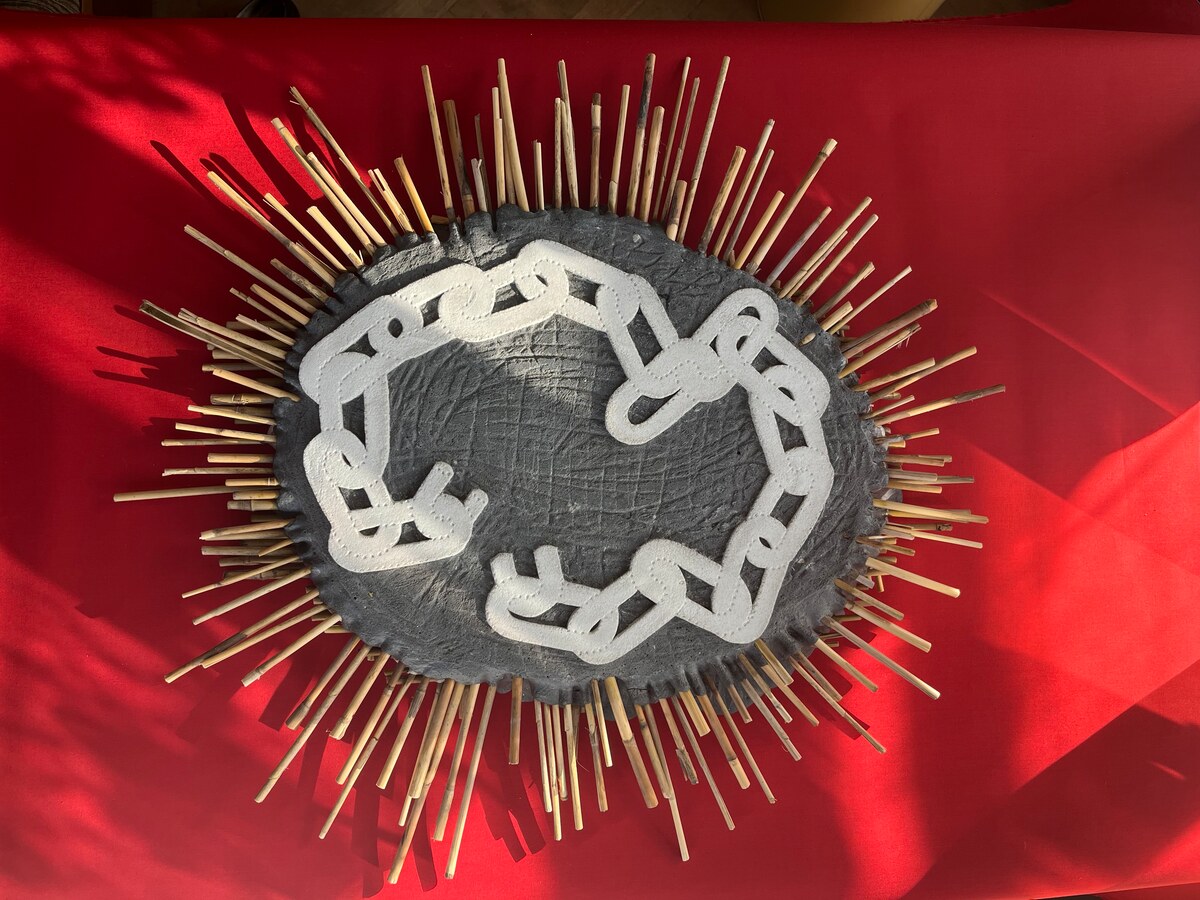
I came to sgraffiti quite naturally: we’re renovating our house and I often have some building material left over. For black I use ash and crushed charcoal from our wood-burning stove. I used to make mosaics; I thought that was my way into exteriors, but it was a dead end. Sgraffito is a wonderful Renaissance technique, and in it I use my main craft – drawing. For now I’m not looking for a commission: either it will come by itself, or else exploring the whole process matters even more right now. I enjoy working with reed and ash, but I’ve also tried polystyrene. And thanks to that experience, including with a larger format, I now know I’m able to make sgraffiti for insulated buildings… just imagine how all those buildings without aesthetic elements on their facades would be transformed with sgraffiti.
Contemporary art in public space here often meets with rejection, and Skuteč was no exception. How do you explain that a large part of the Czech public finds its way to contemporary art with such difficulty? And what would have to change, for example in education, which you also reflect on critically in your work, for people to meet it with curiosity rather than rejection?
A lot would have to change. The very foundations. Above all across the board in art lessons, but I’m not sure we’re capable of such reforms. These are problems that are passed down from generation to generation. To be concrete, I’ll give examples: a child at nursery colours an elephant purple and the teacher tells them it’s wrong. A girl at primary school doesn’t want to do the set assignment in art class, so she makes a different subject, but the teacher tears up her work.
I hate it when adults kill children’s creativity and their creative potential. We can try to defend them by saying that they probably experienced something similar, but they have no right to pass their trauma on. Trauma cannot be an alibi. It’s their trauma, and if they are not able/willing to work with it and resolve it, they shouldn’t teach. Teachers across the board should have to undergo a psychological assessment, at least to detect gross pathology.
I don’t want there to be another misunderstanding, so I’ll go back once more to the essence of the work Ó Europe, I cry for You. It’s an art project focused on working with people, that is, a socially activating intervention in public space. To communicate with people in Skuteč, I chose the term “sculpture”. But in the next town the project will be communicated somewhat differently again. I’d like this project to travel around the European Union, and the several lines contained in the work make it possible to work with the audience in different ways. Education is precisely one of those lines that I reflect on in “my Europe”.
In general, people are frustrated by the conditions of their hard lives. And they consider artists, cultural workers, to be parasites, or egoists. Our work does not have the status of a job. The culture grant system really bothers people: they don’t understand it and so they don’t trust it. Then a few tasteless sculptures for incredible sums appear in public space, and for them that’s the proof. My project did not get a single crown of state money, because I didn’t apply for it; I didn’t want my work to be burdened by this problem.
Skuteč blocks itself from understanding. People here need to rant more than to learn something, or to work something out together. Here I often come up against indifference, insensitivity and lack of education. But the handful of people who came to get acquainted on the guided tours overcame their shyness, and I’m grateful to them for it. The experience with the work Ó Europe, I cry for You is very valuable and instructive for me.
Many people expect art in a square to be pretty. Your fences, deliberately open to anyone who wanted to add something, gradually filled with an incongruous mix of messages and posters. Were you surprised by how their look developed, or did you expect it? Do you deliberately work with the fact that the look of the work irritates people? And is that incongruity an image of the Europe the work speaks about?
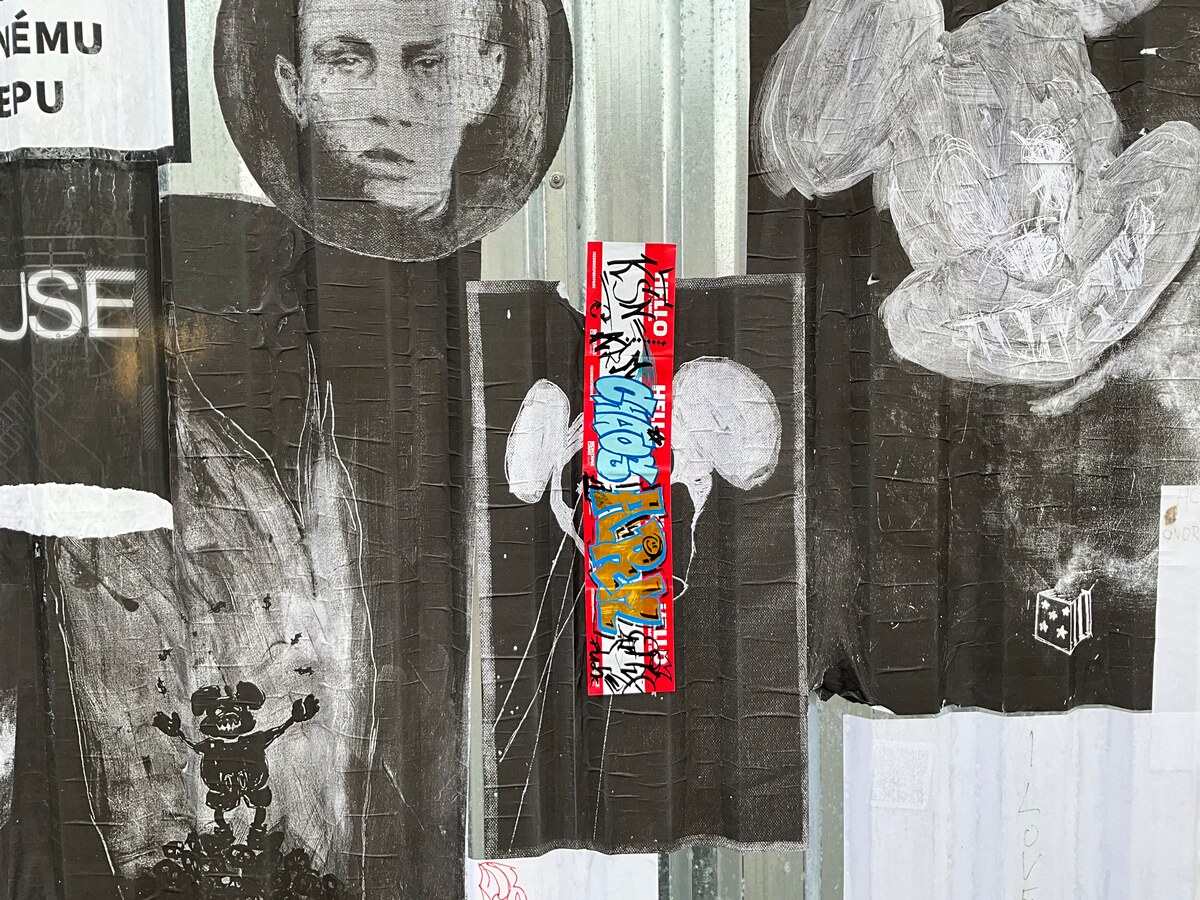
It was important to me that on the edge of that claimed territory the essential and the inessential should mix. The way we normally know it from our online and offline environment. So small ads of the “seeking a woman” type met political propaganda and a poster with a kitten and so on. It took a long time before the surface started to fill up, so that it was clear anyone could contribute anything. People were afraid of the clean surface, afraid to intervene in it. But even after it filled up, it was evident that the fears were still present. That timidity is typical of post-totalitarian countries, and of public spaces under surveillance in particular. I informed the local police that any intervention in my work was fine. My “sculpture” was not meant to be obviously pretty-beautiful, that was not the point at all, but it could have happened too. All it would have taken was for someone to have that intention and paste up, or paint, something like that, I mean something beautiful. The sculpture was simply available to anything. I had collaborations with artists in the works, but in the end I didn’t even manage to paste up all the works. So maybe in the next town there will be more time and more possibilities.
Education, you say, is one of the lines of Ó Europe. You have three children, so you also see school from a parent’s point of view. How do you view the way today’s school treats children’s creativity? And who are your Kakabus figures?
Our children have experienced several models of education, from Montessori and forest kindergartens to the state systems that don’t have my trust. The boys were also in homeschooling after a terrifying period when they experienced bullying that the head teacher was not willing to deal with or even acknowledge. Our eldest son started first grade during covid, so in online teaching. Before that he wasn’t used to sitting at a computer at all. That was unfair. But worse for me was finding out that they were graded through the teachers’ emotions, using smile and sad emoticons. We explained to the children that they aren’t at school to make the teacher happy, and also that a frowny face is not a proper assessment.
Our emotions turned into something… and that something completely called into question everything we can and have the right to experience. Harvey Ball simplified, exploited and sold our emotions by creating the smiley face. Back then he designed it as a reward system for corporate employees. But today it’s used routinely to grade any activity, children’s included.
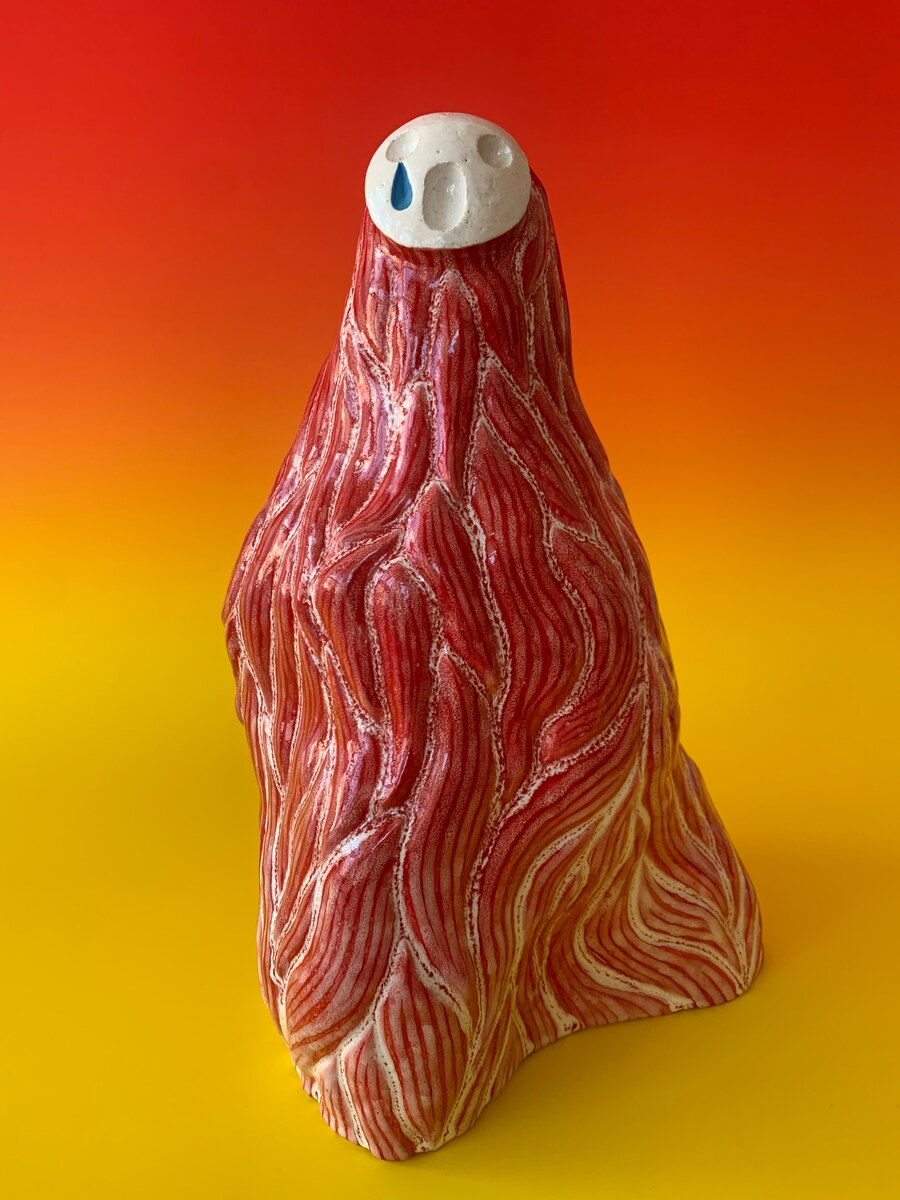
It was precisely in response to these experiences in education that I created the KAKABUS figures. As an answer to the question: what is contemporary figuration?
KAKABUS is a word that many of us know from childhood, in the phrase “netvař se jako kakabus” (“don’t be such a sourpuss”). I formed the organic shapes of the sculptures from clay, with an emoticon mask put on them. It was a way of playing with the simplifying of human emotions, and with social criticism. I had no idea that these very sculptures would become a kind of product of mine. The criticism that I considered part of the sculptures wasn’t noticeable, because people have got so used to emoticons that they no longer actually saw the criticism. But that’s fine, everyone has a right to their own view and interpretation of art.
A large part of your work consists of installations, situations and processes that can’t simply be hung on a wall. The project in Skuteč was supported by the private Kalliopi foundation. How is this kind of creative work funded? And how do you manage to sell your art, and to whom?
As I’ve already suggested, my creative work does not depend on financial reward. Otherwise I would have stopped creating long ago. And it’s true that many times I’ve wanted to give it all up and go and work at Tesco, but I can’t. It’s not a question of choice. I need creating to live, rather like water. Sales are sporadic, small and larger. I work with porcelain, paint in oils, make collages, sgraffiti, I embroider sheet metal with pearls, so lots of saleable things, but few people know it. The isolation of the countryside is another partial problem. Several people interested in visiting my studio changed their minds about the trip when they found out how far away I am. Most buyers stay content within their Prague-centrism. Many of my works are unsaleable by nature, and when my mainly serial pieces do have commercial potential, I don’t resist selling, but I don’t make any great effort for it either. Everything has its time.
You write that you make lots of saleable things, but few people know about them. What experience have you had with commercial galleries? And does the internet bring you interested buyers?
I don’t seek out commercial galleries, and so far they haven’t sought me out either. I’m not on their radar. I’m an artist on the periphery. It would also depend on who got in touch and on what terms. I wouldn’t work with just anyone. That’s the benefit of my freedom: I don’t have to. My work is held by several state institutions and in many private collections. Some collectors come back repeatedly, which makes me enormously happy. The most beautiful thing is when people tell me how good it is to live with my art.
Yes, completely sporadic buyers also get in touch through Instagram, or through recommendations. I’m glad when I know where my things go, into whose hands.
Thank you for the interview!